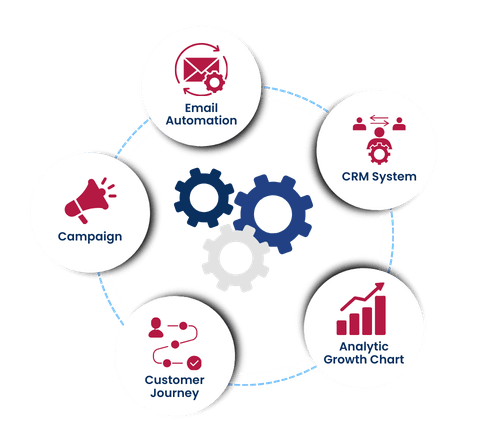
Scale Smarter with Strategic Zoho Marketing Automation
Your competitors are getting 3x the results with half your budget. Why? They’ve moved beyond basic campaigns to intelligent Zoho CRM campaigns that nurture, convert, and retain customers on autopilot. We engineer complete growth systems using Zoho email marketing automation to transform how you acquire and monetize customers.
What’s the difference between Sales Ops and RevOps?
Sales Ops is usually focused on making the sales team faster and more efficient; cleaning pipelines, improving reporting, and removing friction inside the sales process. It’s very “sales-only” in scope.
RevOps is broader. It connects sales, marketing, and customer success so revenue isn’t just generated, but also tracked and improved across the entire journey. That means marketing campaigns, lead quality, follow-ups, and retention all sit in one connected system instead of separate silos.
This is where tools like Zoho CRM campaigns or zoho marketing automation start playing a bigger role because the data isn’t just used for reporting; it actively shapes how leads are nurtured and passed through the funnel. When RevOps is set up properly, teams stop guessing what’s working and start seeing the full picture in real time.
Do I need this if I already use a CRM?
Yes, but it depends on what your CRM is actually doing today. A lot of businesses already have Zoho or similar tools in place, but they’re only using it for basic lead storage and manual follow-ups. In that case, the CRM is more like a database than a system that drives revenue. When you layer in automation, like Zoho email marketing automation, the CRM starts behaving differently. Leads don’t just sit there waiting for someone to act; they move through predefined paths based on behavior, timing, or engagement. Some teams also use Zoho one marketing automation to connect multiple tools together, so marketing activity actually feeds directly into sales instead of operating separately. Without that connection, a CRM alone usually ends up underused.
How long does it take to implement?
There’s no fixed timeline because it depends on how messy or structured the current system is. A simple setup where tools are already clean and data is organized can move fairly quickly. But if we’re dealing with scattered workflows, missing processes, or inconsistent CRM usage across teams, it naturally takes longer.
A typical implementation also includes mapping existing journeys, fixing automation logic, and aligning marketing and sales flows so they actually match real business behavior. That’s where Zoho marketing automation setups often get adjusted because most businesses start with very basic campaigns and later realize they need more structured nurturing. Even something like zoho email marketing automation sounds simple on paper, but when you start connecting it with sales triggers, lead scoring, and campaign segmentation, it becomes a much more layered system.
Do you work with internal teams or replace them?
We usually work alongside internal teams rather than replacing them. Most companies already have people handling sales, marketing, or CRM management; they just need the system to stop creating extra work for them.
In many cases, internal teams are already managing tools like Zoho CRM campaigns or basic email workflows, but the structure isn’t strong enough to scale. That’s where external support helps—cleaning the system, defining logic, and setting up automation that the internal team can actually maintain without constant troubleshooting.
What tools do I need to have in place?
Most businesses don’t actually need a long list of tools; they need the right ones properly connected. Zoho alone can cover a large part of the stack if it’s configured correctly. Depending on the setup, we usually work with combinations like CRM, email systems, campaign tools, and automation layers such as Zoho One marketing automation. In other cases, Zoho email automation and mail campaign systems are enough to start building proper lead nurturing flows.
Let’s Build You a Scalable Growth Engine — Backed by Real Data
Walk away with a 30-day test plan — even if we don’t work together.